All of which means that I'm getting pretty close to giving up on finding a flightless way over. Lou, the other flightless traveller I met here, also gave up and flew to Singapore today.
Anybody have any helpful suggestions?
 An Aboriginal painting I bought off a person on the street in Todd Mall in Alice Springs, by the name of Pango Williams. It is called 'Bush Yam Dreaming' and the brown squiggly shapes represent yams.
This doesn't really warrant an Endurance Rating as it wasn't something to endure. But if I have to give something: a 2, just because of a few fellow passengers.

The Ghan coming into Darwin. You can just see the city in the distance.


Then we went to Uluru to see it during sunset.
This Is What You Want

This Is What You Get

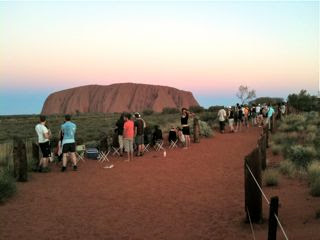
At night, many people chose to sleep under the stars in swag. Remembering what happened to Azaria Chamberlain, however, - who knows if dingos/ Lindy might be around - I elected to sleep in a cabin.
This place is a bit of a shock to the senses. Wretched-looking Aboriginal people are wandering aimlessly about, often drunk. I’d heard there were problems but I didn’t know Australian society had failed so miserably in its treatment of the indigenous population. The white people here carry on like nothing is the matter. I can sense the racial tension and it feels like a powderkeg waiting to explode.

This famous train trip runs between Adelaide and Darwin. I’ve done the first part of it from Adelaide to Alice Springs. I’m staying in Alice for a week that includes a three-day tour of Uluru (Ayer’s Rock) and some other sites and then I will get back aboard the Ghan to go to Darwin. Incidentally, its good to be heading north again, which is my intended direction. Since Brisbane, I’ve been heading south-westerly which is not really the way to England!
The first part of the train trip took about 25 hours and it was great to see some of the outback landscape. Apparently it has had much more rain than usual and so is more green than usual, but I still saw a lot of red desert-like earth. The Ghan railway line was first conceived in 1877 but much of the line was washed away by rain several times over the years. they finally figured out by 2004 where to put the line so that it would last. Its named after the Afghan cameleers who were early explorers of the centre of Australia.
The poster above isn’t actually for the Ghan but I just liked it. Below is some of what I saw.


This three-day trip with a group tour started promisingly: when I boarded the bus on Friday morning I noticed the group had much more women than men, 16 to 6 as it turned out. ‘Brilliant’, I thought, ‘I’m going to enjoy this.’ It soon became clear, however, that I was a slight misfit here. Everyone else was younger than me. I’m in my late thirties and they were mainly in their early twenties. That might not sound like much of a difference, and maybe it usually isn’t, but after trying to talk with a few of them, two things were apparent: (1) they had nothing of interest to say, and (2) they were not interested in anything I had to say. When both those conditions hold, conversations I’m sure you will agree are somewhat difficult.
Only a few hours into the trip, after having some magnificent views along Great Ocean Road, one woman from England whom I will call Whingeing Pom 1 announced ‘this trip is fucking boring.’ Her friend, Whingeing Pom 2, concurred. These two, friends traveling together, were most unpleasant. They seemed to think they had a right to the front two seats on the bus. When on the third day they did not get these seats in the morning, they waited until our first stop, then made sure they were the first to get back aboard the bus, and promptly removed the personal belongings of the others who had sat in those seats and annexed the seats. I also heard Whingeing Pom 1 at one point call everyone else ‘sheep’ because they had followed each other out of the bus.
The tour itself consisted in driving along, stopping briefly at very crowded tourist spots, darting out of the bus to take a photo and then darting back again to continue on the road. In fact, this was the practice of all the tourists I saw along the way who were also traveling in similar groups. Why can’t people actually take the time to pause and LOOK at some beautiful scenery or a historical site? I’m sure they would enjoy it. Instead, however, they joylessly photograph everything and probably never look at the pictures again.
The tour guide’s name was Brian and he looked and talked very much like the Australian actor who plays Kel in ‘Kath and Kim.’ That actor also once starred in a tv series playing a spoof version of the typical Aussie outback bloke, a Crocodile Dundee/ Steve Irwin type. As a result, at first I had to stifle my laughs when he would tell us about the sights and sites, especially when he talked about The Big Tree and its nearby neighbouring trees which were ‘not as big but biggish.’ (They’re called Otway Messmates.)
The first afternoon and evening was spent looking at the Twelve Apostles which are towers of rock sticking out of the ocean close to the coast. There are actually only seven left due to the others falling down over time but as the cliffs become eroded, more might come into existence. The highlights of the second day were MacKenzie Falls and the kangaroos at Grampians National Park. On the third day we climbed Hollow Mountain (also in the Grampians) for an amazing view of the surrounding countryside of Victoria.
The Canadians on board the bus - and one in particular - took it upon themselves to be in charge of the music that was played. Their choices weren’t all bad, but I am staggered that people can so confidently take over in this way without checking with the other passengers that the music choices were acceptable. I guess some people are just certain of their own infallibility. One of them also told a story about how she had been the only person in a crowded bar who did not know that a Boeing 737 was an airplane, and also expressed surprise upon discovering that ‘gesundheit’, said after someone sneezes, was a German word. Ignorant and unashamed of it.
They weren’t all bad though. I made friends with Mariu from Spain and Luciano from Italy. Luciano kept saying I was a genius and I’m not going to argue with that. Julia from England, who has studied classics and philosophy, was also lovely. Next time however, I'm going to make sure before booking any group tour that it is not all young people.
Endurance Rating: 7. Pretty hard-going. At times, I'd rather have been walking the Saharan desert.


The entire crop of rocks is called Hanging Rock after a particular rock formation where a rock seems to hang over the pathway. We passed through this and continued our way until reaching the area of flat rock where the four girls stopped for a rest and fell asleep in the sun. Here, we went off the designated path and weaved our way through some of the narrow passageways in the rocks, finding small clearings leading to further passageways. We made our way further up, with more exploring of the rocks. It is not difficult to see how someone could get lost there. The rocks are tall but narrow and there are so many of them that once you make your way around a few, your sense of direction gets confused and finding the way back is tricky. For a brief moment, I felt lost and unable to work out the way back to the path. I circled round until luckily I found it again. Once at the summit, I climbed to the highest point possible and had a great view of the surrounding Macedon Ranges.

The major theme of the book and the film is the mysteriousness of nature, its oddity and at times otherworldliness compared to the life and activity of humans. Hanging Rock feels like that. You feel like you’re somewhere where you don’t really belong, or, that if you do want to belong, you have to separate yourself from usual worldly affairs. Perhaps that ultimately is the only explanation of the girls’ disappearance.


Australia and New Zealand both fought in the First World War and the battle at Gallipoli in Turkey has become heavily symbolic in both countries, with increasing numbers of people (and increasing numbers of young people) commemorating Anzac Day every April 25th. The reason they fought Turkey is that they were allies of Britain and Britain was at war with Germany who were allies with Turkey. ‘The friend of my friend’s enemy is my enemy’ is hardly a sound basis on which to take action that will kill thousands (and as it turned out, millions) of people. Imagine Amy and Adam are friends and Ben and Bill are friends with each other, but Amy and Ben are enemies. So is it right for Adam to be hostile to Bill? Surely not. So the action at Gallipoli was actually an unjustly hostile invasion of Turkey by Australia and New Zealand. I’ve never seen any suggestion of this in a war museum.
It gets worse actually. Unlike in some other wars, the soldiers who fought for Australia and NZ in the First World War were volunteers. They freely chose to take part in this unjust war. So not only should the governments of the countries be held responsible for declaring an unjust war, but the soldiers themselves ought to be held accountable. Instead of honouring the surviving veterans every April 25th, we should actually be putting them on trial for war crimes.

I’ve spent three days in Australia’s capital city. The first thing that strikes the visitor is how self-important the city is. Parliament House is a huge building inside a circular piece of land and all around is a wide and spacious area dotted with other large buildings and statues. The area looks like it's trying to be Washington D.C and they even call it 'Capital Hill'. It's handy for when you are lost, for you simply scan the horizon for it, but otherwise the area is a sterile, forboding place. A sweeping vista of land leads from the parliament to the lake, and from the other side of the lake to the war memorial. Nearby, the old parliament house has been converted into a Museum of Australian Democracy, recording the 2000 years of development of democracy, as though this was a historical process that was always leading up to a culmination in Australia’s form of government. It is as though this nation - which although geographically large is only a small country of twenty million people - is stamping its foot and saying ‘take me seriously!’ Having said all that, I did enjoy my time here though. I sat in the public gallery of the House of Representatives and heard them debate paid parental leave policies. Prime Minister Kevin Rudd said 'fair dinkum' at one point and another politician said it three times!